


From economic uncertainty, regional instability and geopolitical volatility to supply-chain disruption, cyber threats and extreme-weather events, unpredictability has become one of the biggest challenges facing re-insurers and businesses the world over. Disruption has evolved to become more systemic than episodic, driven by the confluence of unknowable interdependent variables to create unpredictable, cascading, non-linear shocks and risk.
In Aon’s 2025 Global Risk Management Survey, geopolitical volatility features in the top ten global risks for the first time in the survey’s 20-year history. That same survey also shows that worryingly few organisations – just 15% – actually monitor their exposure to the top ten risks, and only one-fifth assess the effectiveness of their insurance through analytics.
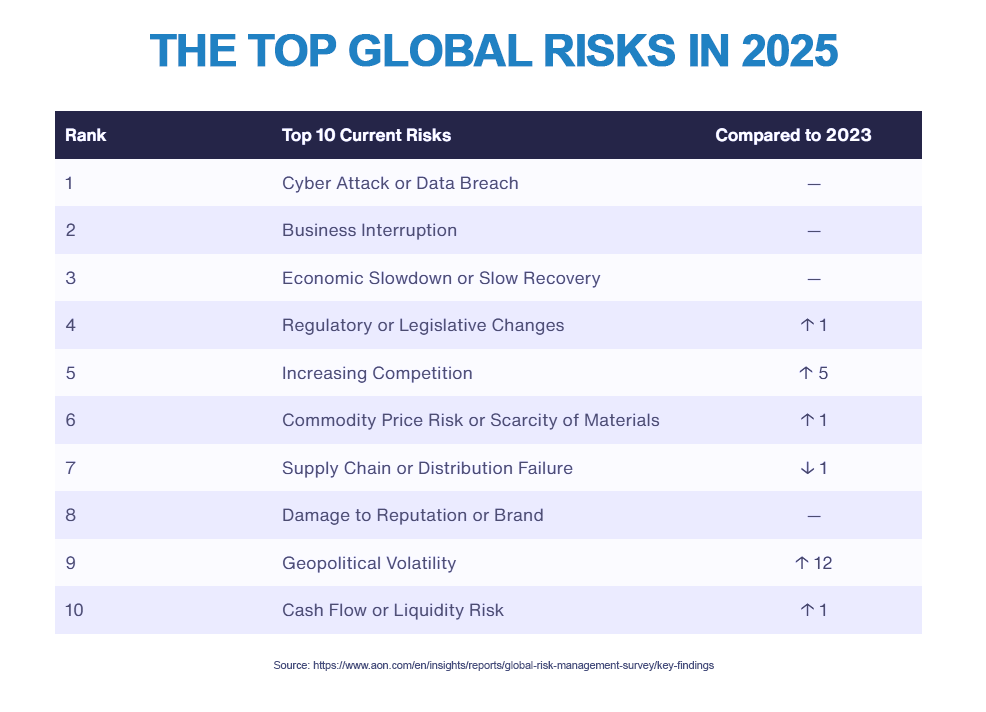
As businesses struggle to navigate a complex, non-linear and brittle global economy peppered with interdependent variables, re-insurers and businesses that can operate in a constant state of adaptation and evolution will equip themselves to thrive in uncertainty. Big-data analytics, digitalisation, and AI enhance risk visibility, allowing re-insurers to quantify threats more effectively. This technological clarity will offer insureds greater confidence that surviving unpredictable events does not require perfect foresight, as insurance and risk management develop together to build resilience into the heart of corporate structures.
How can organisations survive constant disruption?
Over the last few decades, academics, governments and corporations have sought to try and identify, predict and quantify risk in an increasingly unpredictable and interconnected world. Based on the leadership theories of two American academics, the US Army College embraced the acronym VUCA – Volatility, Uncertainty, Complexity and Ambiguity – at the end of the Cold War to help leaders navigate the multiple effects of the collapse of the USSR. More recently, US anthropologist Jamais Cascio, a fellow of the Institute for the Future (IFTF), has argued that another acronym – BANI – better describes the chaotic world in which we live. Alluding to the world’s ~Brittle, Anxious, Non-linear, and Incomprehensible nature, Cascio suggests that a BANI world is in constant flux and faces simultaneous crises, with catastrophe around every corner.
Even more recently, global consulting firm EY has characterised the current situation with its own acronym – NAVI – which alludes to the world’s Non-linear, Accelerated, Volatile and Interconnected nature. “Compared to a few years ago,” notes EY, “we are now in a world where multiple crises strike at the same time — stretching risk functions thin and challenging us to do more with less.”
Whilst many might caution against relying on deceptively neat acronyms as handbooks to navigate a chaotic world, they all imply a need for a new approach to risk management, without which businesses may struggle to survive. At the heart of this approach lies a necessary and close alignment of business strategy with risk management to create resilient companies that can embody the new and overriding imperative of risk strategy. As EY notes, “companies will thrive amid this increased volatility and uncertainty with strategy that is risk-informed, and risk management that is aligned with strategic objectives and metrics. This symbiosis is at the heart of the Risk Strategist.”
The JENOA view: Can organisations re-imagine a reciprocal risk/ business-strategy relationship?
Geopolitical instability can have significant effects on business interruption, supply chains and the free flow of trade. Those threats are exacerbated by the constant risk of cybercrime, which ranks as the highest risk for both private and public organisations. Many data breaches and cyber attacks are originating from state-sponsored actors, and this kind of attack tends to increase as diplomatic tensions between nation states grow. Re-insurers and businesses also contend with independent cyber criminals operating for financial gain as well as hacktivists – those using cybercrime to advance ideological, political or social causes by causing maximum disruption. As a result, the threat landscape becomes ever more difficult to predict as interdependencies grow more opaque. With information overload increasing – content generation is expected to double every three years to top 2,000 zettabytes by 2035 – organisations often struggle to identify information critical to making good decisions through all the white noise.
Indeed, decision-making in the context of corporate strategy is significantly hampered by the interconnectedness and interdependencies of the modern global economy and the threat landscape, where opaqueness and complexity cloud our ability to understand or predict cause and effect. More interdependencies lead to greater complexity, making it infinitely more difficult to analyse or understand them. In other words, unclear or ambiguous interdependent variables – combined with the sense of urgency that inevitably accompanies the unease created by instability and uncertainty – adversely affect a business’s ability to make good, well-informed and robust decisions.
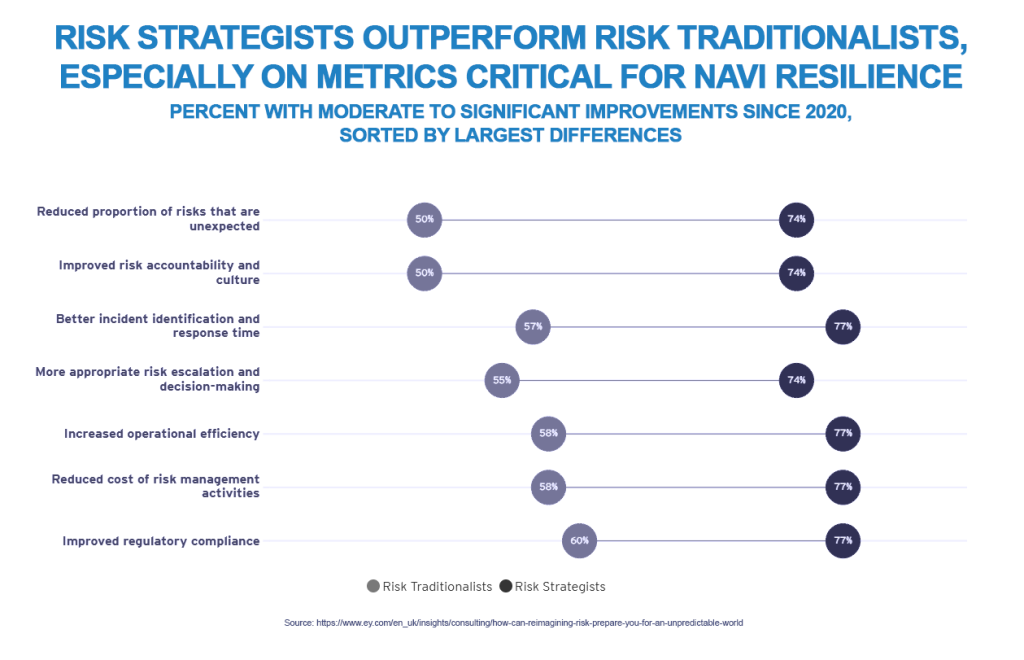
Whilst emerging, unpredictable global risks and geopolitical volatility are increasingly reshaping the re-insurance and business landscape, some businesses are building effective resilience to deliver on strategic goals by leveraging emerging risk intelligence and placing it at the heart of their business strategy. Often known as ‘risk strategists’, these businesses report a vastly improved ability to respond rapidly to incidents, as well as a significant reduction in the likelihood that they will be surprised or endangered by external shocks.
Organisations that take a risk-strategist approach have fundamentally reimagined the relationship between business strategy and risk, transforming that relationship into one that is itself interdependent. “[The] relationship between risk and business strategy and growth is reciprocal,” says EY. “[Risk strategists] not only align the risk function with their organization’s strategy but also inform strategic decisions with risk insights to drive business growth.”
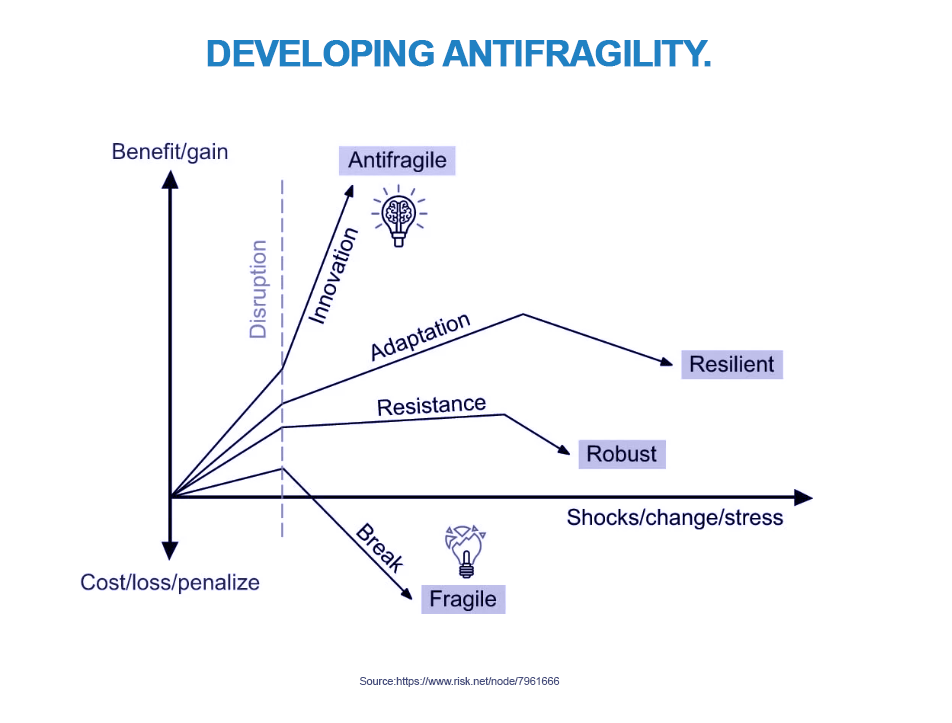
As digitalisation, big-data analytics and AI become more widespread, agile re-insurers can harness emerging risk intelligence to adapt and evolve rapidly in a fast-changing risk landscape. This will allow them to support transformation and help organisations build the resilience they need to weather financial shocks and thrive in an unpredictable global economy. In that pursuit, organisations that understand the need for investment and embed risk management into their business strategy and corporate structure will be better placed to deal with disruption and adapt with greater ease. As risk-management and brokerage firm Gallagher notes, “pre-loss investments in risk management strategies pay off.”
With closer alignment between risk and business strategy, many risk-strategist organisations have reported that their improved tolerance to risk has allowed them not only to weather uncertainty but also to take advantage of disruption to diversify operations, innovate their products or services and create new revenue streams.
What does this mean for MENA clients and how can JENOA help?
Regional instability and operational uncertainty can create new avenues for responsive digital-product development and insurance cover. After all, uncertainty can spawn new markets and products; a vastly enhanced appreciation of a company’s increased exposure to risk through better visibility can often be offset with extended tailored cover to address economic, operational and geopolitical risk.
JENOA offers broad experience and expertise in helping re-insurance clients in the MENA region adapt rapidly and evolve to thrive in an era of systemic disruption and volatility.
With access to the Lloyd’s of London market and re-insurance hubs worldwide, JENOA leverages global insurance innovation alongside re-insurance capacity to help discover and mitigate hidden risk. That enhanced risk visibility through improved data analytics can help organisations cut through the white noise of information overload to enable more informed decision-making.
Can organisations thrive amidst the flood of interconnected variables?
As Aon’s 2025 Global Risk Management Survey notes, with volatility now a permanent feature of the global economy, re-insurers will see more demand to integrate analytics, strategic risk management and tailored coverage to offset today’s emerging risks. Aon’s findings suggest that successful re-insurers will rapidly adapt products and services to an emerging risk landscape driven by geopolitical volatility, business interruption, cyber risk and extreme weather.
With unpredictability now an integral part of everyday business operations, companies that can adapt, build resilience and leverage emerging risk intelligence will develop a tolerance to risk, enabling them to take advantage of disruption and operate more effectively in our increasingly uncertain world.
Disclaimer: This publication is provided for general informational purposes only and does not constitute legal, financial, investment, insurance, or other professional advice. Any forward-looking statements, projections, or opinions expressed herein are based on information available as of the date of publication and are subject to change without notice. JENOA Ltd. and JENOA Risk Management Ltd. accept no liability for any loss or damage arising from reliance on the content of this publication.